Impact project for Climate Block testing ground in the Agniese neighbourhood / Zomerhof District in Rotterdam
There are major opportunities for climate adaptation in the private urban domain. Making buildings and private properties more climate resilient can make an important contribution to the main goal of the Delta Programme on Spatial Adaptation: creating a climate-resilient Netherlands by 2050. Many adaptation measures are already well known, such as disconnecting rainwater pipes, installing green roofs and adding more greenery to urban areas. However, in 2015 these measures were still not common practice in cities. This impact project aims to help change that.
Results
The study was carried out by De Urbanisten and Superuse Studios, commissioned by the Schieland and Krimpenerwaard Water Board and housing corporation Havensteder. The research was part of the Spatial Adaptation Incentive Programme and received financial support from the Dutch Ministry of Infrastructure and the Environment.
The study explored opportunities for climate-adaptive measures at the scale of urban blocks. The Agniesebuurt/Zomerhofkwartier area in Rotterdam served as a testing ground. In this neighbourhood, close to Rotterdam’s water square, three different types of urban blocks were studied: a 19th-century block, a block from the 1980s and a newly planned residential complex.
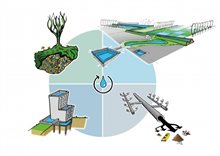
A wide range of measures was collected to improve both buildings and climate resilience. In this study, solutions were developed for:
- water storage on roofs and along building facades;
- storage and reuse of rainwater;
- water storage in and under gardens;
- water storage at the street side of buildings.
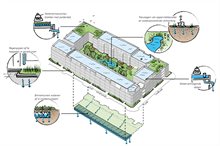
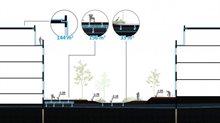
A combination of measures was designed for each urban block, depending on the local situation. In all cases, it is useful to collect rainwater in stages, store it temporarily and discharge it slowly. Where possible, the water can also be reused. Combined with greenery, for example on a polder roof, these measures can also help cool the neighbourhood.
The study also shows that these measures can improve the quality of the living environment in several ways. Examples include accessible roof gardens, greener inner courtyards and rain gardens along streets. Because these water collection measures are clearly visible, they also help raise awareness about water management and the importance of making cities climate resilient.
Contact person
Dirk van Peijpe
De Urbanisten
+31(0)6-31 005 530
dirkvanpeijpe@urbanisten.nl