Impact Project Program Development of Peat Area in Woerden
The municipality of Woerden is situated mainly in a peat area. Oxidation, shrinkage, and settling have caused significant surface level subsidence over recent decades. Based on the current use of the landscape, the rural area is expected to subside by 30 to 50 cm in the next 50 years. The urban area may even subside by as much as 75 cm.
This surface level subsidence has a major impact on built-up areas. It causes pluvial flooding of streets and roads, thus creating unsafe situations for pedestrians, cyclists, and motorists. Non-uniform settlement causes damage to houses and foundations. Roads are destroyed by traffic, gardens continue to subside, sewage pipes succumb, and service pipes break off.
To the municipality, this surface level subsidence entails that public spaces in the peat area require more effort in terms of management and maintenance than do other areas. Experience has taught that sewage and roads require maintenance and replacement approx. three times more frequently.
The village of Kanis
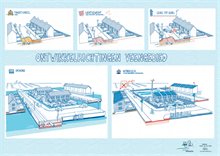
The municipality of Woerden has requested the incentive programme for support in the reconstruction of the village of Kanis. During the design phase, explicit attention will be focused on peat issues. Two design ateliers have examined technical innovations and the life cycle of various solution strategies. Residents of the village of Kanis have also been actively involved in the design ateliers.
Results
Lessons
Involving residents at an early stage of a reconstruction, especially an extraordinary one such as that of the village of Kanis, enables them to offer their input and call on their own know-how and networks, just like other – professional – parties involved, in order to weigh in on creative and innovative solutions. The residents are alert, aware, and committed to the solutions adopted for their own neighbourhoods. Furthermore, since they are included early on in the process, they are open to new ideas. It is a joint quest, in which residents have been able to share the values of their village and submit these as a basis for the further approach to the reconstruction.
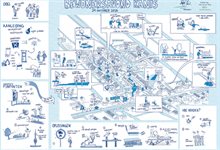
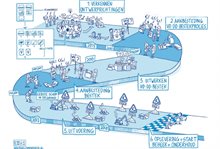
During this process, the ideas and ambitions discussed at the start were gradually translated into practical options. This helped residents understand how these ideas could work in real life. In some cases, residents realised that certain solutions did not fit well with their daily lives. For example, the wish for fewer cars in the streets could mean parking cars in central locations or outside the village. Many residents eventually felt that this was not a suitable solution.
This created room for other ideas that better matched the wishes of the residents of Kanis. These solutions could differ from one street to another. To support this, street sessions were organised as part of the design process. This made it possible to create tailor-made solutions for different parts of the village.
Contact person
Welmoed Visser
Gemeente Woerden
+31(0)6 51 02 70 58
visser.w@woerden.nl