Climate-proofing Hoogeveen impact project
The municipality of Hoogeveen aimed to develop a strategy to climate-proof the Hoogeveen city centre. This strategy needs to be implemented in plans and projects covering the Hoogeveen city centre.
Results
The municipality and the water board carried out a stress test of the city centre to identify the main climate challenges. The next step was to decide which measures were needed based on the results of this test. To explore possible adaptation measures, a masterclass was developed with support from the Spatial Adaptation Incentive Programme. The masterclass was aimed at staff working in areas such as green space, sewer systems, water management and spatial planning. During the masterclass, participants worked on practical solutions for making Hoogeveen more climate resilient. They also learned more about different aspects of climate adaptation, and several measures were tested in practice.
Hoogeveen was selected as an impact project because the challenges in the municipality are similar to those in many other municipalities. The masterclass approach may also help other municipalities take practical steps towards becoming more climate resilient.
Masterclass Session 1: Analysis
The first session brought together a wide range of participants, including staff from water boards, engineers from consultancy firms, municipal advisers from different fields, and a representative from the national government. To better understand climate challenges, it is important to observe, investigate and ask questions. This was the starting point of the three subprojects that together formed the impact project: a rainfall stress test, a heat stress test and a water structure design. During the session, the results of these subprojects were shared and discussed with all participants. The invitation already made the aim clear: “I look at the city through a different lens.” The addition of 3D glasses to the invitation encouraged many people to attend. With support from the University of Groningen, the rainfall stress test model was converted into a 3D model.
Masterclass Session 2: Ambition
One month after the 3D session in Groningen, the second session took place at the Drents Overijsselse Delta water board and focused on “Ambition”. In 2010, the municipality of Meppel installed water-permeable paving in the Ezinge neighbourhood. Since then, the municipality has maintained the paving in the same way as regular paving, without extra sweeping or cleaning. This raised the question of whether the paving still worked properly. Some municipal and water board staff believed that water-permeable paving does not work well, especially without additional maintenance.
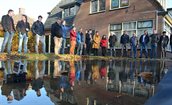
For the masterclass, students from Hanze University of Applied Sciences fenced off part of a street and surrounded it with a small dike. The area was then flooded in the presence of the participants. This clearly showed that the paving still allowed water to pass through. A few days later, measurements confirmed the results. Although the performance was lower than at the start, the results were still good.
The session helped to clear up misunderstandings and led to new insights. By testing ideas in practice, participants were able to discuss and challenge assumptions about climate-resilient design. This created space for new ideas and further discussion, and prepared the group for the final session.
Masterclass Session 3: Action
The final session took place in Hoogeveen, the area at the centre of the project. To keep the session active and interactive, participants worked at four different tables.
Two of the tables focused on maps showing locations that had been identified as important during the earlier “analysis” session. Special attention was given to the squares in Hoogeveen and to a major traffic junction on the ring road. Participants discussed possible solutions, while also considering the practical limitations. This led to valuable insights and showed how different professional backgrounds can lead to different ideas and perspectives. In some cases, it also helped specialists look at the situation in a new way.
At another table, Johan Bouma from Wareco explained the water structure design. Participants discussed opportunities for the neighbourhoods surrounding the structure. Again, the different disciplines brought different perspectives to the discussion. The results proved both valuable and practical.
Towards the end of the first round, the responsible alderman and a member of the water board also joined the session. They experienced themselves how challenging, but also how valuable, it is to look at climate issues from multiple disciplines at the same time.
Contact person
Thomas Klomp
Municipality of Hoogeveen
0528-291175