
Kockengen Waterproof: village being raised in order to prevent future waterlogging
Kockengen Waterproof is a programme in which the Municipality of Stichtse Vecht, the Stichtse Rijnlanden District Water Board (HDSR) and the Province of Utrecht worked together with residents on solutions to the village's subsidence and flooding problems. These challenges are increasing as a result of climate change. Longer periods of drought and higher temperatures accelerate peat degradation, while heavy rainfall more frequently leads to flooding in the streets. The video below shows how Kockengen was affected by flooding on 28 July 2014.
The “Agenda 2063” that has been drawn up for Kockengen Waterproof is a perspective of the future underpinned by three pillars: village, polder, and water. For the Village section, a policy document and an implementation programme have been drawn up, setting out how the village of Kockengen will be future-proofed and which solutions have been selected.
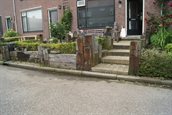
Roads, footpaths and public green spaces throughout the village have been raised in phases over a ten-year period. Existing roads and foundations were removed, a new separate sewer system was installed, utility companies renewed their underground infrastructure, and the public space was raised using lightweight fill materials. Front gardens were brought back to the new ground level and the public space was redesigned.
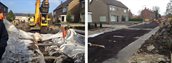
The redesign of the public space created opportunities for residents to contribute ideas and express their wishes. This included suggestions for green spaces, parking areas and playgrounds.
The degree of subsidence in combination with the age and quality of the existing sewer system has greatly added to the urgency of taking measures. To implement such measures, Kockengen has been subdivided into 10 different sub-sections; these sub-sections will be tackled in phases.
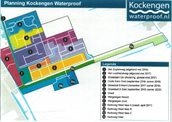
In 2015, sub-section 1 – Van Zuylenweg and vicinity – was designated as a pilot project. Work on this sub-section was successfully completed by mid-2016. The experience gained in terms of technological and choices of materials has been taken into account in sub-section 2: Van Lockhorstweg.
The work on sub-section 2 commenced in mid-2016 and was successfully completed by mid-2017. This sub-section presented some difficulty due to the location of the existing sewers in the back passages. The house service connections were moved to the front of the houses and joined to the new sewer system. The experience gained in this sub-section was taken into account in sub-section 3: Groenlust 1.
The work on sub-section 3 Groenlust 1 commenced in early 2017 and was successfully completed by mid-2018. This sub-section showed evidence of the many layers of asphalt applied in the past in order to level up the road. The removal of 2.5 m thick layers of asphalt was no exception.
Work on Sub-area 5 (Groenlust II North) was completed at the end of 2018. This was followed by the preparation and completion of Sub-area 4 (Oude Kern East) and Sub-area 6 (Groenlust II South).
The other sub-sections will be prepared and tackled in the years ahead.
Lessons to be learned from the project
- Residents are closely involved in the project. This garners support and appreciation for the measures and the work. An added bonus is that local knowledge is shared. Feedback panels are set up for each sub-section to collectively review the improvement or adaptation of the public space. This has generated highly positive experiences.
- In theory, the sub-sections have been set down based on logical delineations. In practice, however, work often needs to be carried across the boundaries of a sub-section.
Technical lessons to be learned from the project
- The inspection pits with telescopic shafts that were chosen upon the launch of the project enable the accommodation of light settlements. As the inspection pit is composed of two parts and the groundwater level is high, there is a risk of groundwater leakage in the inspection pits around the connection between the two parts.
- Lightweight fill materials in the sewer trench are highly water permeable and act as drainage. This causes a great deal of excess water in future work on the sewer. Compartmentalising the sewer sections is recommended in order to be able to remove the water.
- Lightweight fill materials are difficult to compact. As a result, such materials will settle in the course of time. Such settlement is not caused by the weight but rather by the settling of such materials. This presents a distorted picture of the actual settlements.
Contact person
J. Nieuwenbroek
Gemeente Stichtse Vecht
Jules.nieuwenbroek@stichtsevecht.nl
140 346