
The Rain Tower: a network of smart rainwater buffers on private property
The municipality of Enschede worked with residents to explore how rainwater could be managed in the city. To this end, the municipality of Enschede, the University of Twente and the Vechtstromen district water board developed the ‘Rain Tower’: a network of smart rainwater buffers at private homes.
Additional water storage, raising awareness
To store water during extreme rainfall, the municipality of Enschede invested €6.3 million in a 7,000,000-litre water storage facility in the city centre. Additional storage capacity is needed to continue preventing waterlogging under a changing climate. Additional rainwater buffers at carefully selected locations can help extend the value of this investment. However, the municipality cannot provide all this additional capacity on its own. It is also essential for private individuals to store water, as 70 per cent of the rainwater discharged by the sewer system originates from private property.
This prompted the municipality of Enschede, together with the University of Twente and the Vechtstromen district water board, to develop the Rain Tower: a network of smart rainwater buffers that collectively provide additional water storage. A buffer consists of a rainwater tank and a computer-controlled system that uses a weather forecast to determine when the buffer should be emptied so that it can store new rainwater. With the Rain Tower, the parties aimed not only to increase water storage capacity, but also to raise awareness of rainwater and groundwater among private individuals.
From Creathon to Pilot
The idea for the smart rainwater buffer arose in mid-2016 during the Twente creathon on urban climate effects. A creathon is a format involving students working on solutions to a societal problem for twenty-four hours in a row. The idea named the “Ensketon” was conceived by Creative Technology students of Twente University.
The Ensketon idea was subsequently elaborated in several graduation projects within the Creative Technology programme. These projects showed that, from a technological perspective, it was feasible to develop a working prototype of a smart rainwater buffer and have it respond to a weather forecast: when extreme downpours are expected, the buffer will empty itself (into the garden or the sewer system), thus creating additional water storage. The prototype which was developed turned out to enthuse residents. The positive results encouraged the parties to set up the “Rain Tower” project.

Image: Prototype of 500-litre rainwater buffer (© Hendrikjan Teekens, 2017)
Hendrikjan Teekens: "With this project, we are substantiating the Enschede Lab, an organisation aiming to have students work on societal issues in the city in which their university is located. In our experience, students tend to prefer such topics: what they come up with is actually implemented in the city. Businesses located at the Science & Business park next to the University are also involved in this project. Many of their staff are alumni of the University."
Rain Tower pilot: esidents test the smart rainwater buffer
In early 2019, the project partners launched a pre-pilot at the homes of seven project participants. This was followed by plans for a pilot involving twenty-five private homes. Their gardens were to be equipped with a smart rainwater buffer with a capacity of 250 litres. A second pilot was also planned, involving an XXL version of the buffer with a capacity of 20,000 litres. This XXL version was intended for business premises.
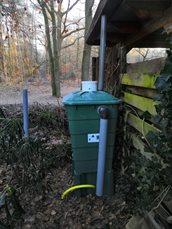
Image: 250-litre rainwater buffer for the pre-pilot (© Hendrikjan Teekens, 2019)
During the pilot, the performance of the smart rainwater buffer was evaluated with the participants. Where possible, any necessary adjustments could be made immediately. The aim was to develop the Rain Tower concept further and prepare it for large-scale use. The main research questions were:
- How can the rain barrel be properly adjusted to the weather forecast? Experience teaches that showers can develop differently at the last minute. In such cases, the barrel can let the water go whilst the shower passes or vice versa.
- Sewerage involves a robust and low-maintenance system featuring high operational security. In principle, the rain tower system must meet these same requirements. How can this be achieved?
- What insights into the use of their smart rainwater buffer do residents want?
- What insights into the performance of the network of smart rainwater buffers do the municipality of Enschede and/or the Vechtstromen district water board want?
- To what extent does the “Rain Tower” contribute to the rainwater storage tasking in Enschede? (The municipal buffers will start to operate once the sewer system has reached its maximum processing capacity and water is threatening to flow into the streets, whereas the private buffers will start to operate before any rain has fallen.)
In addition to exploring the performance of smart rainwater buffers, the 2019 had several other purposes:
- Preparing the smart rainwater buffer for private individuals and businesses;
- Setting up a targeted publicity campaign to promote the acceptance and adoption of smart rainwater buffers;
- Elaborating an organisational format for the realisation of the “Rain Tower” featuring thousands of smart rainwater buffers;
- Incorporating the additional private storage capacity into the municipal sewerage data.
Future perspective for the Rain Tower
As part of the project, the parties explored whether the municipality could encourage the use of smart rainwater buffers, for example by offering them at a reduced price.
An XXL version was also explored as a possible way for businesses to contribute to the municipality’s rainwater storage challenge. Scale is important to the Rain Tower concept: the greater the combined capacity of the rainwater buffers, the greater their potential contribution. Industrial estates offer considerable space for large buffers. Buffers with a capacity of more than 1,000,000 litres can make a significant contribution to reducing waterlogging.
In addition to reducing waterlogging, the parties involved also considered other possible uses for the Rain Tower. During dry weather and periods of low groundwater levels, for example, stored water can be used to water plants and trees and help prevent them from drying out. In this way, individual rainwater buffers can also raise awareness of rainwater and groundwater among residents.
The XXL version of the smart rainwater buffer was also seen as a potential feature in public space, for example by involving artists and designers in its design.
Costs of public versus private solutions
Public water storage costs around one euro per litre. As part of the project, the municipality could explore the extent to which private storage facilities contribute to public water storage. This can provide another perspective when comparing private and public investments.
Lessons to be learned from the project
In the past, the municipality’s water management task mainly focused on underground infrastructure: the sewer system. Enschede was where wadis were developed in 1992 as an above-ground form of rainwater management. Water storage in public space has since become widely accepted. With the development of the Rain Tower, a further step was explored: storing water where the rain falls, on private and business premises.
Contact persons
Richard Bults
University of Twente / Creative technology
Smart XP supervisor
r.g.a.bults@utwente.nl
+31618965627
Hendrikjan Teekens
Ontwerper water
Gemeente Enschede
Hj.teekens@enschede.nl
+31613168686
Jeroen Buitenweg
Beleidsmedewerker Waterschap Vechtstromen
j.buitenweg@vechtstromen.nl
+3121882326