
Climate adaptation solutions at Euvelgunne industrial estate
In Groningen's Euvelgunne industrial estate, the sewers were overloaded during severe downpours, causing local waterlogging and sewer overflows in the city centre. From 2018 to 2023, the municipality of Groningen explored measures to combat this. In addition, several entrepreneurs planted about 2,800 trees in Euvelgunne in 2023 through a 'front-runner project'.
What could the municipality do about the sewer overflows?
To find out what it could do about the sewer overflows, the municipality of Groningen carried out two pilot projects. It worked together with the Groningen water authorities, the Groningen-Assen Region and the Zuidoost Business Association. In the first pilot, the municipality, in collaboration with the district water boards and the business association, explored whether businesses could disconnect the downspouts at their own premises and use the rainwater. The point of departure in this respect was that it was up to the businesses to implement the measures at their own premises. In the second pilot, the municipality developed a sewer control model in concert with the district water boards. With the control model, the municipality can determine when it is better to pump sewage to the treatment plant or discharge it directly.
What was the goal of the pilots?
The main goals of the pilots are:
- Relieving the sewer system to reduce overflow in the city centre. The aim was to eventually disconnect 180,000 m² of paved surface;
- Convincing several companies to disconnect their downspouts and use their rainwater smartly. All these measures together could be used to compile a showcase, featuring different solutions which other industrial estates could use.
In addition to combating waterlogging, the municipality also intended that these measures should foster the energy transition, biodiversity, circularity, the landscape, and the reduction of heat stress.
How have businesses been encouraged to disconnect downspouts?
The municipality has shown all the businesses on the estate a book of examples, featuring different measures for disconnecting downspouts, for reusing and retaining rainwater, and for infiltrating rainwater into the ground. The authorities have also reviewed the wishes of the businesses. Subsequently, proposals were elaborated for each business. A municipal grant scheme has been set up in the purview of the implementation of the measures.
What results have been obtained?
Detailed information about the project can be found on the project website [in Dutch]. An evaluation report was prepared by the Euvelgunne Sounding Board Group in December 2023. This contains information about the project organisation, financing, time schedule and activities, project results, and experiences and recommendations. A large number of companies cooperated in this project and carried out adaptation measures. A selection of the results:
- Businesses use rainwater as cooling water and for flushing toilets, thus fostering a circular economy;
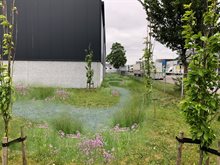
- One bioswale has specifically been designed to enhance biodiversity. This wadi has been seeded with a flowery mix;
- Less water ends up in the sewer system, thus reducing overflows;
- Companies have installed sedum-herb rooftops, with carnation species and bluebell, for example, for biodiversity;
- Bioswales cool the environment;
- The participating businesses were positive;
- The sewer control model functioned well during a wet period in February 2020. After that, it was further improved.
In 2021, the bioswale near Salomon’s Metalen metalworks was monitored during a wet period. In 2022, the bioswale was monitored during a dry period. The bioswale design capacity is aimed at the collection of a 20 mm downpour. The first study showed that during a wet period, the bioswale can handle a 16 mm downpour without any problems. Probably, a 20 mm downpour will not pose any problems either. According to the study pertaining to the dry period, the groundwater level remains well below the bioswale floor. Rainwater will infiltrate the soil at an average rate of 3 cm per hour.
Businesses enthusiastically get to work
It was good to see how enthusiastically the businesses have embarked on their efforts. For example, the business that constructed a biodiversity wadi has also created a giant insect hotel. Another business was so proud of its measures that it used drones to make a short film of the process.
Businesses plant a 'front-runner forest'
In March 2023, several businesses planted 2,800 trees on an area of 1.4 hectares as part of a front-runner project. This 'front-runner forest' is the first forest planted for and by entrepreneurs. The action partly compensates for the fact that it is not yet possible to run businesses completely CO₂ neutral. A forest close to the business area makes it visible and tangible for all businesses in Euvelgunne. They can become a ‘moral owner’ by adopting a part of the forest. The forest also helps reduce heat stress and waterlogging. In addition, it improves the living environment and supports biodiversity.
Lessons to be learned
In its evaluation report, the Euvelgunne Focus Group makes a large number of recommendations, including the following:
- Start the project with all responsible parties: all parties could bring in their own problems and solutions. Then, together they searched for an objective and an approach that all parties could support. This ensured support from all parties and contributed to all of them actively participating.
- Ensure the project has a driving force: most municipality and water boards staff were not able to lead this project in addition to their regular work. Therefore, it was very good to have an external project manager for this.
- Provide a skilled contact person for the companies: in implementing the measures, the "downspout disconnection coach" played a crucial role. The companies regarded him as a reliable interlocutor they could do business with.
- Communicate actively and deliberately about the project: some participants felt afterwards that the project could have gotten more exposure. Outside the circle of colleagues and participating companies, the project was hardly known. Even companies in neighbouring industrial estates turned out not to know about the project despite all the communication activities.
Contact persons
Eric Ebbers
Technical specialist water
Gemeente Groningen
e.ebbers@groningen.nl
Ramon Hoiting
Bestuur@koplopers.nl
+31 (0)6 587 74 891