
Neighbourhood bioswale renders The Hague community greener and raises public spirits
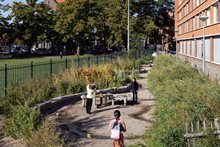
Since 2022, the Transvaal neighbourhood in The Hague has accommodated the Future Garden. This 300 m² garden is maintained by residents, schools and various neighbourhood organisations. A major part of this future-proof garden consists of a “neighbourhood bioswale”: a facility that collects water during severe downpours and enhances social cohesion within the neighbourhood by bringing residents together.
How has the neighbourhood bioswale been realised?
Initiator Zairah Khan of Re-city started out as a volunteer in the Future Garden. Together with local residents, she planted fruit trees, bushes and other greenery. In summer, however, the garden was hot and dry, as a result of which almost everything died. Khan then came up with the idea of creating a bioswale in the garden. She contacted housing corporation WoonInvest, owner of the adjacent building, which houses a nursing home. Khan suggested creating a bioswale and using that to collect rainwater from the rooftop.
Why a neighbourhood bioswale?
The idea behind the neighbourhood bioswale is that it provides the entire community with a place to hang out. It is a water buffer with a strong social function. The bioswale collects rainwater and allows the water to slowly seep into the soil, and also enhances biodiversity in the garden. Furthermore, the neighbourhood bioswale helps to prevent waterlogging and leakage in the surrounding area, and it is a place where locals can meet. Visitors engage with nature and get to know one another better. The garden welcomes nursing home residents and staff, and children can play in the water playground.
What were the main challenges?
One of the challenges was the huge surface area of the nursing home rooftop: 1,500 m2. A study showed that a bioswale with a storage capacity of 60,000 litres could collect rainwater from this vast rooftop. Fortunately, the garden could accommodate such a high-capacity bioswale. The efficient design allows the water to easily seep into the soil, both width-wise and depth-wise. As a result, the bioswale can even deal with an extreme downpour occurring once a century. It cost around €80,000 to build, and was funded by a wide range of partners and grant-giving bodies.
Useful willow trees
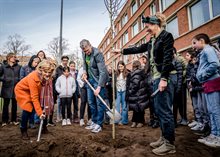
Some 200 species of plants and trees have been planted in the garden. The aim of this level of variety is to identify species that are optimally resilient against both dry and wet periods. The first tree in the neighbourhood bioswale was a willow tree. Willow trees are highly resilient against extreme downpours and drought. Their roots loosen the soil, thus facilitating water infiltration during rainfall, and during dry and hot periods, the willow tree provides cooling. For that reason, additional willow trees will be planted.
Gathering knowledge
The Future Garden is a place to learn and try out things. Consequently, the construction of the first neighbourhood bioswale here, as a pilot project, makes sense. It has already produced a great deal of knowledge: on suitable plants, on arranging maintenance with healthcare institutions and schools, and on the technology of urban water and soil.
Lessons to be learned
- Are you considering constructing a neighbourhood bioswale or something similar? If so, you should take the following issues into account:
In a city, water is the joint responsibility of the municipality and the district water board. As a result, it is not always clear who will address what, leading to urban water management falling through the cracks. In this project, getting all the parties on board took a long time; preparations took more than 1.5 years. It would be wise to take this into account when setting up a similar project. - A project cannot always run on volunteers only. It needs an organisation that continues to support and maintain the project, such as the municipality or a school, healthcare institution or housing corporation. This opens up opportunities for municipalities and district water boards. Municipalities need to embark on climate adaptation, but many are not sure how to involve their residents in the efforts. A neighbourhood bioswale will help. Residents and users will appreciate municipal assistance at the onset, but it is important for the project to remain their own.
- The extent of the maintenance that can be carried out by residents will differ from one location to the next. That is why it is important to continue to assist, for example by hiring a professional company to occasionally take care of major maintenance. In such cases, sharing knowledge is also important, as many greenery or maintenance workers will not be familiar with bioswales.
Contact person
Zairah Khan
Re-city
zairah@re-city.nl
Read more?
You may also be interested in: