
Ga naar de inhoud
Climate Adaptation Platform Netherlands (naar homepage)
Direct naar
  • About us
  • Sitemap
  • Nederlands
  • Caribbean
  • Helpdesk
  • Home
  • Get started
  • Knowledge dossiers
  • Tools
  • Examples
  • Library
  • Policy and programmes
  • About us
  • Sitemap
  • Nederlands
  • Caribbean
  • Helpdesk
  1. Home ›
  2. Knowledge dossiers ›
  3. Urban water quality ›
  4. How is climate change affecting water quality and aquatic life? ›
  5. Abiotic factors ›
  6. Uitklappen phosphorus and nitrogen

Uitklappen phosphorus and nitrogen
Sources

Jeppesen E, Kronvang B, Meerhoff M, Søndergaard M, Hansen KM, Andersen HE, et al. Climate change effects on runoff, catchment phosphorus loading and lake ecological state, and potential adaptations. J Environ Qual. 2009; 38(5):  1930-41.

Kosten S, Schep S, van Weeren BJ. Een frisse blik op warmer water: Over de invloed van klimaatverandering op de aquatische ecologie en hoe je de negatieve effecten kunt tegengaan. Amersfoort: STOWA; 2011.

Boers PCM. Studying the phosphorus release from the Loosdrecht Lakes sediments, using a continuous flow system. Hydrobiological Bulletin. 1986; 20 (1): 51-60.

Genkai-Kato M, Carpenter SR. Eutrophication due to phosphorus recycling in relation to lake morphometry, temperature, and macrophytes. Ecology. 2005; 86 (1): 210-9.

Bouraoui F, Grizzetti B, Granlund K, Rekolainen S, Bidoglio G. Impact of Climate Change on the Water Cycle and Nutrient Losses in a Finnish Catchment. Climatic Change. 2004; 66 (1): 109-26.

Chang H. Water Quality Impacts of Climate and Land Use Changes in Southeastern Pennsylvania*. The Professional Geographer. 2004; 56 (2): 240-57.

Jeppesen E, Kronvang B, Olesen JE, Audet J, Søndergaard M, Hoffmann CC, et al. Climate change effects on nitrogen loading from cultivated catchments in Europe: implications for nitrogen retention, ecological state of lakes and adaptation. Hydrobiologia. 2011; 663 (1):1-21.

Paerl HW, Huisman J. Blooms Like It Hot. Science. 2008; 320 (5872): 57.

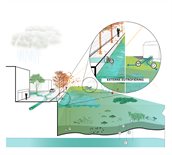
External eutrophication

External eutrophication means that phosphorus and nitrogen concentrations in the water are increasing due to external sources. The main cause is changes in precipitation levels: on the one hand, increasing winter precipitation and torrential summer rain, and on the other, increasing summer drought, resulting in stagnant water. In addition, rain itself also contains nitrogen, so rain volumes play a part too.

Increase in nitrogen

The increase in nitrogen is mainly caused by increasing rainwater runoff and by sewer overflows onto surface water.

Increase in phosphorus

The increase in phosphorus concentrations is mainly caused by sewer overflows: sewage water contains a lot of phosphate, a common form of phosphorus. During severe precipitation, green rooftops and trees can also constitute a source of phosphorus. Another cause of external eutrophication is the inlet of foreign water. Water originating from rural farmland usually contains large concentrations of nutrients.
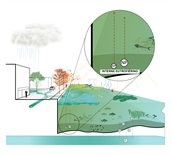
Internal eutrophication

Internal eutrophication means that the increasing concentration of phosphorus and nitrogen in the water can be attributed to the aquatic system itself. This happens as follows: higher temperatures accelerate the decomposition of organic matter, both in the water and in the sediment at the bottom. The decomposition of organic matter releases phosphorus and nitrogen. Especially in shallow water, the temperature will rise rapidly in warm weather. In such cases, the sediment may release double the volume of phosphorus. The thicker the layer of sediment, the more phosphorus it may release. The top layer of the sediment could even turn anoxic, which would release additional phosphorus into the water. Furthermore, the temperature affects the pH values of the water and thus the rates of decomposition.

Stagnant water is conducive to the process

If water remains stagnant for a prolonged period of time due to drought, nitrogen and phosphorus concentrations will remain high. Flushing with flowing water may reduce the high nitrogen and phosphorus concentrations. In dry periods, inlet water may produce the same effect.


Share this
  • Delen op Facebook
  • Delen op LinkedIn

Helpdesk

mail-ballon-transparant

Please use the contact form to contact the editors if you have any questions or comments regarding climate adaptation or this website.

Joining forces to accelerate climate proofing!

The Climate Adaptation Knowledge Portal is the pre-eminent source of information for everyone engaged in climate adaptation. It provides practical information, useful tools, inspiring examples and the latest news.

About this website

  • About us
  • Disclaimer
  • Privacy statement
  • Contact
  • Accessibility
  • Archive

Follow us

LinkedIn