Nutrient content
A high nutrient content constitutes the basis for many water quality issues. For example, high concentrations of phosphorus and nitrogen in water promote the growth of algae and duckweed, which crowd out aquatic plants. The paragraphs below explain more about the various control variables that affect a water system’s nutrient content. The table below shows how climate change can affect these control variables.
Climate change can raise the nutrient content of water systems in various ways. For example, heat accelerates the decomposition of organic matter, which adds to the release of nitrogen and phosphorus. Foreign water let in during a period of drought can be rich in nutrients, thus raising the nutrient content of the receiving water. Severe downpours may cause sewer overflows, which also raise the nutrient content of a water system.
Influence of control variables on nutrient content
The paragraphs below outline the most important control variables that can affect the nutrient content of a water system by burdening it with nitrogen and phosphorus:
The nutrient content of a waterbed is directly dependent on its soil type. For example, peat contains more nutrients and organic matter than sandy soil. Nutrients from the waterbed end up in the water system. Peat soils, therefore, increase the nutrient content of the water system, thus rendering it more vulnerable. The nutrient content of the soil is a system characteristic which cannot be altered by implementing measures.
A sewer overflow is an opening in a combined sewage system that allows sewage water to be discharged onto surface water. This can be necessary in the event of sewer overloads as a result of severe precipitation. Sewer overflows cause sharp and sudden increases in a water system’s nutrient content. In combined sewage systems, this effect is more marked than in separate systems. Surface water in the vicinity of a sewer overflow regularly discharging sewage water is significantly impacted by this control variable. Surface water a relative distance away from a sewer overflow or near an overflow discharging little sewage water is less vulnerable to sewer overflows.
Keeping a water system up to par regularly requires letting in water from a main water system. Sometimes, the water from the main water system contains more nutrients than the water system letting it in. In such cases, the nutrient content of the receiving water will increase. Letting in water with a significantly higher nutrient content will render the receiving water system highly vulnerable. Inlet water with a similar or lower nutrient content will not compromise the vulnerability of the receiving water system.
A thick layer of mud on the waterbed means that the water system is rich in nutrients. The mud may release nutrients into the surface water, thus raising its nutrient content. A mud layer thicker than 15cm renders the water system highly vulnerable. A mud layer of 5cm to 10cm makes the water system moderately vulnerable; a thickness of less than 5cm means that the water system is not vulnerable.
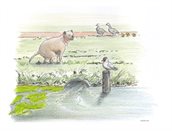
Urban surface water is often bordered by footpaths or dog walking fields. Dog poo runoff during downpours will cause nutrients to end up in the water, thus raising its nutrient content. Large quantities of dog poo on the waterside and dog walking sites adjacent to a watercourse will render the water system highly vulnerable. If there is no dog walking site adjacent to the watercourse but there is dog poo on the banks nonetheless, the water system will still be vulnerable.
Some urban bodies of water are home to large quantities of water birds. Birds are a major source of nutrients, if they reside on and near the water in large groups. The nutrients end up in the water either directly via their droppings or indirectly via rainwater runoff. As a result, the nutrient content of the surface water will increase. At locations that regularly accommodate many geese or other water birds and where there are a great deal of bird droppings along the water, the water system will be highly vulnerable to the inflow of bird droppings. For more exact limiting values regarding the vulnerability, see the sheet on Control variable: Inflow of bird droppings in the i-report.
The fertilisation of kitchen gardens, gardens or green rooftops fosters the proper growth of crops and vegetation. However, a proportion of the nutrients from the fertilisers will run off onto surface water, thus increasing its nutrient content. A water system is highly vulnerable to fertilisation of the vicinity if the watercourse is located adjacent to a kitchen garden complex or other fertilised grounds. If not, the water system will not be impacted by this control variable.
Leaves from trees around the body of water will introduce nutrients into the water. Compared to sewer overflows, dog poo and bird droppings, leaf fall constitutes a relatively minor source of nutrients. The volume of leaves falling onto a watercourse will depend on the distance between the trees and the watercourse, the tree species and the municipal management. A water system will be highly vulnerable to leaf fall if more than 50 per cent of the waterside consist of trees shedding leaves onto the water. If 25 per cent to 50 per cent of the waterside contain trees shedding leaves onto the water, the water system will be moderately vulnerable. A waterside without any trees means that the water system is not vulnerable.
In part, the vulnerability of a water system to these different control variables depends on its use. Is the water used for swimming, as cooling water, as drinking water or for irrigation? The limiting values differ for each functional use and also differ from one water system to the next. For various functional uses, the Urban Water Quality, Climate and Adaptation Tool indicates approximate limiting values for the control variables outlined above. These limiting values are not geared to a water system and can, therefore, only be used on an indicative basis.
Effect of climate change on the control variables
The table below shows how climate change impacts the various control variables that together determine the nutrient content of a water system. For example, the table reflects that increasing waterlogging causes more sewer overflows, which may have a negative effect. At the same time, sewer overflows are decreasing as a result of the increasing drought, which is a positive effect. More information can be found in the Excel file on Functional Uses of Water Types (xlsx, 499 kB). The table below has been derived from a table in this file, which is contained in sheet “Effects of climate change”, part C.
| Control variable | Heat | Waterlogging | Drought | Watersafety |
|---|---|---|---|---|
| Nutrient content of the soil (type) | ||||
| Sewer overflow | Increase, negative | Decrease, positive | ||
| Inlet (nutrient-rich) water | Decrease, positive | Increase, negative | Decrease, positive | |
| Nutrient content of the soil (mud) | Increase, negative | |||
| Dog poo runoff | Increase, negative | Decrease, positive | ||
| Inflow of bird droppings | Increase, negative | Increase, negative | Decrease, positive | |
| Environmental fertilisation | Increase, negative | Decrease, positive | ||
| Leaf fall | Increase, negative |
Are you interested in the quantitative effects per water system? These can be determined using the calculation tool, the Guide to Water Quality Stress Tests. Climate change and water quality, developed by the Foundation for Applied Water Research (STOWA). Or use this guide to draw up a detailed water and substances balance based on climate prognoses.