Pollution
(Micro)pollutants such as heavy metals, medicine residue and pesticides are harmful to life in and around surface water. Faecal pollution poses health risks: people swimming or bathing in such water may become ill. The paragraphs below explain more about the various control variables that affect the pollution of a water system. The table below shows how climate change can affect these control variables.
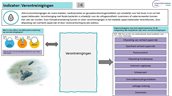
As a result of climate change, more pollutants can end up in urban surface water. Rainwater runoff from (paved) surfaces may carry pollutants. Sewer overflows during severe precipitation can increase pollution. In addition, rising soil temperatures are likely to accelerate the release of pollutants from the soil.
Impact of control variables on pollution
The most important control variables that may affect water pollution are:
When it rains, rainwater carries pollutants from paved surfaces to surface water. The larger the paved surface area, the more pollutants will run off. A water system directly bordered by more than 75 per cent of pavement is highly vulnerable to pollution through runoff. If 25 per cent to 50 per cent of the adjacent area is paved, with a green zone separating the pavement and the water, the water system will be moderately vulnerable. The water system is not vulnerable to pollution from runoff if it is bordered by a green zone and if less than 25 per cent of the adjacent area is paved.
When it rains, rainwater carries pollutants from paved surfaces to surface water. Such pollutants can be heavy metals, oil or organic matter. The degree of pollution mainly depends on the porosity of the pavement. Adjacent pavement consisting of asphalt concrete renders the water system highly vulnerable to pollution. Pavement consisting of a mix of asphalt concrete and slabs or pervious concrete renders the water system moderately vulnerable to pollution. If the pavement consists of slabs or pervious concrete, the system will not be vulnerable to pollution.
A sewer overflow is an opening in a combined sewage system that allows sewage water to be discharged onto surface water. This can be necessary in the event of sewer overloads as a result of severe precipitation. Sewer overflows cause sharp and sudden increases in a water system’s nutrient content. In combined sewage systems, this effect is more marked than in separate systems. Surface water in the vicinity of a sewer overflow regularly discharging sewage water is significantly impacted by this control variable. Surface water a relative distance away from a sewer overflow or near an overflow discharging little sewage water is less vulnerable to sewer overflows.
Urban surface water is often bordered by footpaths or dog walking fields. Dog poo runoff during downpours will cause nutrients to end up in the water, thus raising its nutrient content. Large quantities of dog poo on the waterside and dog walking sites adjacent to a watercourse will render the water system highly vulnerable. If there is no dog walking site adjacent to the watercourse but there is dog poo on the banks nonetheless, the water system will still be vulnerable.
Some urban bodies of water are home to large quantities of water birds. Birds are a major source of nutrients, if they reside on and near the water in large groups. The nutrients end up in the water either directly via their droppings or indirectly via rainwater runoff. As a result, the nutrient content of the surface water will increase. At locations that regularly accommodate many geese or other water birds and that have a great deal of bird droppings along the waterside, the water system will be highly vulnerable to the inflow of bird droppings. For more exact limiting values regarding the vulnerability, see the sheet on Control variable: Inflow of bird droppings in the i-report.
Boats equipped with a marine toilet cannot dump wastewater onto surface water; they are required to use a collection system to empty the toilets. However, not all boats are equipped with such a system. In addition, the systems in ports and marinas are not used consistently. As a result, at certain locations, discharge from boats can result in high concentrations of faecal bacteria and other pathogens. This poses health risks for those using the water, such as swimmers. If a watercourse accommodates many boats equipped with marine toilets, the water system will be highly vulnerable to pollution. If it does not accommodate boats, or only accommodates non-motorised boats, the water system will not be vulnerable to this type of pollution.
The cheapest way to kill weeds on paved surfaces is spraying herbicides. However, such herbicides can run off onto surface water. This will have a negative impact on flora and fauna, and on drinking water production. Nowadays, the professional use of herbicides and pesticides on paved surfaces has been outlawed. The use of herbicides to kill weeds near the water will render a water system highly vulnerable to pollution.
Sewer systems are designed for longevity. However, excessive pressure may cause sewer pipes to burst. Such pressure may come from ingrowing tree roots, subsidence, severe frost or heavy traffic. As a result, sewage water will unintentionally end up in the environment, including in surface water. High concentrations of faecal bacteria and other pathogens will pose health risks to those using the water, such as swimmers. Furthermore, high concentrations of such substances will have a negative impact on aquatic life. A sewer system constructed prior to 1960 in which leaks are detected regularly will render a water system highly vulnerable to pollution. If leaks are detected regularly in a sewer system constructed prior to 1980, the water system will be moderately vulnerable to pollution. If the sewer system has been constructed after 1980 and no leaks have been reported yet, the water system will not be vulnerable to pollution.
Swimmers are a source of faecal bacteria. Small children bathing without swimming nappies are a particular source of pollution. The extent to which water can be polluted by swimmers greatly depends on the total number of swimmers gathered in the water. If daily numbers total more than 50 swimmers, the water system will be highly vulnerable to pollution. A total daily number of more than 20 swimmers will still make the water system vulnerable to pollution. High concentrations of faecal bacteria and other pathogens pose health risks.
In part, the vulnerability of a water system to these different control variables depends on its use. Is the water used for swimming, as cooling water, as drinking water or for irrigation? The limiting values differ for each functional use and also differ per water system. The Urban Water Quality, Climate and Adaptation Tool indicates approximate limiting values for the control variables outlined above. These limiting values are not geared to a water system and can, therefore, only be used on an indicative basis.
Effect of climate change on the control variables
The table below shows how climate change impacts the various control variables that together determine the nutrient content of a water system. For example, the table reflects that increasing waterlogging causes more sewer overflows, which may have a negative effect. At the same time, sewer overflows are decreasing as a result of increasing drought, which is a positive effect. More information can be found in the Excel file on Functional Uses of Water Types (xlsx, 499 kB). The table below has been derived from a table in this file, which is contained in sheet “Effects of climate change”, part C.
| Control variable | Heat | Waterlogging | Drought | Watersafety |
|---|---|---|---|---|
| Runoff on paved surfaces | Increase, negative | Decrease, positive | ||
| Porosity of paved surfaces | ||||
| Sewer overflow | Increase, negative | Decrease, positive | ||
| Dog poo runoff | Increase, negative | Decrease, positive | ||
| Inflow of bird droppings | Increase, negative | Decrease, positive | ||
| Shipping | Increase, negative | |||
| Herbicides | Increase, negative | Increase, negative | Decrease, positive | |
| Sewer leakage | Increase, negative | Increase, negative | Increase, negative | |
| Swimmers | Increase, negative |
Are you interested in the quantitative effects per water system? These can be determined using the calculation tool, the Guide to Water Quality Stress Tests. Climate change and water quality, developed by the Foundation for Applied Water Research (STOWA). Or use this guide to draw up a detailed water and substances balance based on climate prognoses.