
Ga naar de inhoud
Climate Adaptation Platform Netherlands (naar homepage)
Direct naar
  • About us
  • Sitemap
  • Nederlands
  • Caribbean
  • Helpdesk
  • Home
  • Get started
  • Knowledge dossiers
  • Tools
  • Examples
  • Library
  • Policy and programmes
  • About us
  • Sitemap
  • Nederlands
  • Caribbean
  • Helpdesk
  1. Home ›
  2. Knowledge dossiers ›
  3. Urban water quality ›
  4. What makes a water system vulnerable to climate change? ›
  5. Through-flow

Through-flow

Stagnant water containing fertilisers or toxins is vulnerable and prone to issues. Water that remains stagnant for a long period of time and that contains sufficient nutrients will foster the growth of algae, blue-green algae and duckweed. The paragraphs below explain more about the various control variables that affect the through-flow of a water system. The table below shows how climate change can affect these control variables.
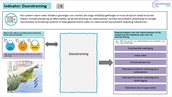
Afbeelding indicator doorstroming
Screenshot from the knowledge document. Downloading the knowledge document (pdf, 13 MB) gives you access to the interactive pages.

Climate change will impact the through-flow of water systems via heat, drought and waterlogging. In a prolonged period of heat, more water will evaporate, as a result of which the depth and through-flow of the water will decrease. Decreasing groundwater seepage pressure as a result of drought will also reduce the through-flow. On the other hand, letting in foreign water during drought will increase the through-flow. Furthermore, through-flow will increase in the event of waterlogging, as this will lead to more water being drained.

Effect of control variables on through-flow

The most important control variables that may affect the through-flow are:

Blind watercourse

Many urban water systems contain blind angles, for example, ditches without culverts, running perpendicular to a dam or dyke, watercourses with weirs or far corners of a pond. These are locations featuring stagnant water, which may cause issues with, e.g., excessive growth of duckweed, floating algae beds or (blue-green) algae. A watercourse is highly vulnerable if the water cannot continue to flow, for example, in a blind watercourse. A watercourse that is temporarily closed is moderately vulnerable. Watercourses connected to other watercourses, in which water can flow freely, are not vulnerable.

Inlet water

Periods of drought often require letting water into a water system from a main water system in order to keep the water level up to par. Water that is let in will flow through the system. An inlet system can also be used to flush a water system suffering from poor water quality, for example, because the water has been stagnant for a prolonged period. A water system without any options for letting in additional water is highly vulnerable. A system is moderately vulnerable if water cannot be let in during drought. A system that can always let in sufficient inlet water to ensure its through-flow is not vulnerable.

Groundwater supply

In minor water systems, such as wells and brooks, seepage ensures a constant flow. In such systems, seepage supplies sufficient water to create a flow. This is not the case in larger water systems, such as ponds and canals. Here, stagnant water adds to the probability of issues arising from, for example, duckweed, floating algae beds or (blue-green) algae. A system is not vulnerable if its flow rate exceeds 0.5mm of water per day.

Resistance in bottom layer of water from aquatic plants

Aquatic plants obstruct the through-flow of water. The extent to which aquatic plants obstruct such through-flow depends on the flexibility of the aquatic plants, their volume and their spread across the water system. For example, an open flow course prevents stagnation of water, whereas in an overgrown watercourse, water may remain stagnant for quite a long period of time. Is the through-flow of a water system visibly limited because of aquatic plants? Then the system will be highly vulnerable to issues arising from, for example, excessive duckweed, floating algae beds or (blue-green) algae. Are aquatic plants visibly limiting through-flow at a few locations? Then the system will be moderately vulnerable to such issues. If the through-flow is not affected by aquatic plants, the water system will not be vulnerable.

Resistance in top layer of water because of culvert situation

Culverts are continuous connecting pipes between watercourses. If a culvert is situated too low, duckweed, branches and other debris will pile up and block the culvert, thus obstructing through-flow of the water. In order to guarantee through-flow, the top of a culvert must always rise some distance above the waterline. Is a culvert situated entirely under water, and do you see duckweed piling up in front of it? Then the water system will be highly vulnerable to issues arising from, for example, duckweed, floating algae beds and (blue-green) algae. A culvert that is situated sufficiently high in order to allow duckweed to pass but is partially blocked will render the water system moderately vulnerable to such issues. A system is not vulnerable if it has no culverts or if duckweed can easily pass the culverts and the culverts are not blocked.

Resistance from tight culvert

Culverts are continuous connecting pipes between waterways. Culverts that were installed in the past are now increasingly too narrow to transport all the water during heavy rainfall. The water then comes to a temporary standstill. Is this the case? If so, it makes the water system very vulnerable to problems caused by, for example, duckweed, flab, and (blue-)green algae. Is the culvert large enough to transport all the water during heavy rainfall? Then it does not make the system vulnerable.

In part, the vulnerability of a water system to these different control variables depends on its use. Is the water used for swimming, as cooling water, as drinking water or for irrigation? The limiting values differ for each functional use and also differ per water system. The Urban Water Quality, Climate and Adaptation Tool indicates approximate limiting values for the control variables outlined above. These limiting values are not geared to a water system and can, therefore, only be used on an indicative basis.

Effect of climate change on the control variables

The table below shows how climate change impacts the various control variables that together determine the nutrient content of a water system. For example, the table reflects that increasing waterlogging causes more sewer overflows, which may have a negative effect. At the same time, sewer overflows are decreasing as a result of the increasing drought, which is a positive effect. More information can be found in the  Excel file on Functional Uses of Water Types  (xlsx, 499 kB). The table below has been derived from a table in this file, which is contained in sheet “Effects of climate change”, part C.

Effect of climate change on the control variables
Control variable Heat Waterlogging Drought Watersafety
Blind watercourse Increase, negative
Inlet water Increase, positive Decrease, positive Increase, positive
Groundwater supply Increase, positive Decrease, negative Increase, positive
Resistance in bottom layer of water from aquatic plants Increase, negative
Resistance in top layer of water because of culvert situation Increase, negative
Resistance from tight culvert Increase, negative

Are you interested in the quantitative effects per water system? These can be determined using the calculation tool, the Guide to Water Quality Stress Tests. Climate change and water quality, developed by the Foundation for Applied Water Research (STOWA). Or use this guide to draw up a detailed water and substances balance based on climate prognoses.
kijkwater
  • Urban water quality
    • How is climate change affecting water quality and aquatic life?
    • How does climate change impact functional water quality?
    • How vulnerable is a water system to climate change?
    • What makes a water system vulnerable to climate change?
      • Nutrient content
      • Through-flow
      • Water temperature
      • Oxygen content
      • Salt content
      • Pollution
    • How do adaptation measures affect water quality?
    • How can negative effects on water quality be countered?
    • How can you design an area with an eye for water quality and climate change?

Share this
  • Delen op Facebook
  • Delen op LinkedIn

Helpdesk

mail-ballon-transparant

Please use the contact form to contact the editors if you have any questions or comments regarding climate adaptation or this website.

Joining forces to accelerate climate proofing!

The Climate Adaptation Knowledge Portal is the pre-eminent source of information for everyone engaged in climate adaptation. It provides practical information, useful tools, inspiring examples and the latest news.

About this website

  • About us
  • Disclaimer
  • Privacy statement
  • Contact
  • Accessibility
  • Archive

Follow us

LinkedIn