How has the Netherlands organised waterlogging strategies?
Over recent years, the district water boards, provinces, municipalities and national government have taken a wide range of steps to protect the Netherlands against increasing precipitation. For example, brooks and drainage canals have been widened and buffers have been created to collect torrential rain. In the built environment, bioswales have been constructed, whilst gardens and rooftops have been greened. But what exactly is the policy in terms of waterlogging? At what locations are measures being implemented and why? What agreements have been made, and what standards have been set down?
Stricter standards in case of higher risk
The first consideration in the design of the water system is the extent of the impact of waterlogging. The higher the impact would be, the greater the need to keep the probability of waterlogging occurring as low as possible. For example, in a residential area, where water can flow into houses, flooding will generally cause more damage compared to the temporary inundation of a meadow. For that reason, stricter standards usually apply to built environments.
What standards and agreements are in place? Important elements of policy on waterlogging are:
- Provincial standards apply to waterlogging in regional water systems.
- Agreements on the sewer system have been made at the municipal level: what section of the sewer system falls under municipal responsibility? What section falls under the responsibility of individual residents?
- The assessment of water interests in plans for spatial planning of the physical living environment.
- A retention-storage-drainage strategy is in place: water must first be retained locally, at the location at which it falls, and the excess must temporarily be stored in storage areas or basins. Rainwater that cannot be processed through retention and storage can be drained.
Current standards and strategy need to be modified
Following the National Administrative Agreement on Water (2003), standards were introduced for waterlogging ensuing from the regional system. However, climate change is making it increasingly difficult to design the water system in accordance with these standards. For that reason, the authorities are now exploring how the current waterlogging standards and strategy can be updated.
What is the current strategy?
Under the Water Act, the standards for regional waterlogging had to be incorporated into provincial regulations with effect from 2009. This has resulted in considerable investments to bring and keep the water systems up to par. The standards are explained in the box below. These waterlogging standards are based on the utilisation of the land and reflect the “water follows function” approach: rainwater needs to be drained to the sea as quickly as possible, via drainage pools or brooks and rivers.
What needs to change?
The “water follows function” approach does not adequately align with the principles of multi-layer safety and the directive role of water and soil. Furthermore, in some cases, the approach is at odds with the water taskings of drought, water quality and reducing soil subsidence. For example, valuable rainwater is sorely needed in the increasingly frequent dry periods. Options for adapting the standards are, therefore, currently being explored. The intention is to remove bottlenecks in the current approach, create more scope for an area-oriented approach and give more priority to investments in areas facing the highest societal risks.
Current water system standards (not for the Caribbean Netherlands)
As a result of the Cabinet response to the recommendations of the Committee for 21st century Water Policy and under the National Administrative Agreement on Water, design standards were drafted for waterlogging originating from surface water, prompted by the water issues affecting northern and western parts of the Netherlands in 1998. These standards pertain to waterlogging originating from the water system, not to local waterlogging caused by extreme rainfall. Under the Water Act, provinces had to incorporate these regional waterlogging standards in their provincial regulations with effect from 2009. Many water systems date from before 2009 and have not been designed in accordance with these standards, meaning some may not conform to the design standards.
The provinces set down the standards for the regional water systems, whilst the district water boards ensure that the regional waters have sufficient storage and drainage capacity. In legal terms, the standards pertaining to waterlogging have been set down as “environmental values for water systems”; they are included in the provincial environmental regulations. See item 4 of the table in the box below: “Inundation from surface water”. This standard concerns the probability of waterlogging in an area, expressed in return frequency. The environmental values are expressed in the probability of surface water levels exceeding the ground level. In built areas in most parts of the Netherlands, the maximum return frequency for waterlogging from surface water is once every 100 years.
In principle, landowners are responsible for processing excess rainwater on their premises. If that is not possible, the municipality will process the rest of the rainwater via facilities in public space. In such cases, the municipality is responsible for drainage to the regional water system.
As great volumes of rain need to be drained via the sewer system, the municipalities have drawn up a practical guideline for sewers. The point of departure is that the maximum return frequency for street inundation is once every 2 years. During extreme rain, the sewer capacity will not suffice. That is why the ground level design is vitally important, to be able to process and drain rainwater.
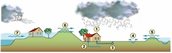
| Waterlogging | Regulations | Standard |
|---|---|---|
| 1. Roof leakage | N/A | N/A |
| 2. Excessive groundwater levels | N/A | N/A |
| 3. Sewer overload and/or ground level design | Practical guideline for sewers | Variable: once every 2 years to once every 100 years for new developments |
| 4. Inundation from surface water | (Provincial) standard for waterlogging (Environment Act) | Once every 10 to 100 years |
| 5. Failure/overtopping of regional flood defences | Provincial regulations | Once every 10 to 1000 years |
| 6. Failure/overtopping of primary flood defences (flood risk management)* | Environment Act | Once every 100 to 1,000,000 years |
*Note for item 6. Failure/overtopping of primary flood defences (Environment Act 2.15, sub paragraph 3):
The point of departure for setting down the environmental values as referred to in the first paragraph, introduction and sub d, is a minimum protection level that will reduce the probability of individual deaths as a result of flooding behind the primary flood defences to no more than 1 in 100,000 per annum by 2050. A higher protection level will be enforced at locations where flooding could cause:
- Large numbers of fatalities,
- Substantial economic damage, or
- Serious damage resulting from failure of vital and vulnerable infrastructure of national importance.