Adaptation Pyramid
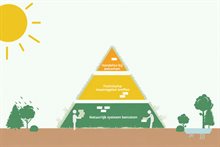
All the regional governments are working on rendering the Netherlands climate-proof and water-resilient. But how can you tell whether you are heading in the right direction? Are you taking appropriate measures or are you perhaps overlooking some issues? The Adaptation Pyramid will provide more insight into such matters. This visual tool developed by Climate Adaptation Services can help you to collectively address questions such as: Are we on the right track with our current climate adaptation policy? Are we selecting the correct measures to keep pace with climate change? Do we need to adjust our course? Are we really working on a resilient and climate-proof system?
For whom?
The Adaptation Pyramid is primarily intended for regional government authorities: municipalities, district water boards and provinces. It is one of the tools used under the national Delta Programme for Spatial Adaptation (DPRA). This approach helps both regional government authorities and the national government to set down climate adaptation goals in more concrete terms. The DPRA Steering Group encourages all government authorities to use the Adaptation Pyramid in their risk dialogues.
How can the Adaptation Pyramid be used?
The Adaptation Pyramid can be used in discussions on the goals to be set in terms of climate adaptation. For example, the Pyramid can help to collectively formulate specific climate adaptation goals. However, it can also be used to collectively assess whether the current goals in pursuit of a climate-resilient system need adjusting. Furthermore, the Pyramid can be helpful in garnering support from colleagues for adaptation tasks, or bolstering collaboration in the region. Useful in this respect are the interactive tool and other free workshop materials) (zip, 8.9 MB), such as posters, building blocks and DPRA Maps of Opportunities.
Who has developed the Adaptation Pyramid?
The Adaptation Pyramid has been developed by Climate Adaptation Services, in collaboration with several government authorities. The following government bodies have contributed to its development: the Hoogheemraadschap van Delfland district water control board, the Waterschap Vallei en Veluwe district water board, the province of Gelderland and the municipalities of Dordrecht, Ede, Apeldoorn, Leusden and Wageningen.
Date of publication
15 January 2026