
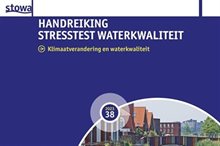
Guide to Water Quality Stress Tests
Which bodies of water are vulnerable to the impact of climate change, and why? The Guide to Water Quality Stress Tests helps water management bodies map out such vulnerabilities. It shows where water quality and aquatic life are prone to the impact of climate change, and also maps out measures that are required to keep the water clean and healthy.
For whom?
This Guide is intended for municipalities, district water boards, Rijkswaterstaat (the executive branch of the Ministry of Infrastructure and Water Management) and provinces working on climate adaptation and water quality. The method is focused on urban water systems but also useful for rural areas. The Guide can also be used by private property owners.
How can the Guide be used?
In three steps, the Guide enables you to determine the vulnerability of the water quality in a water system:
- Conduct an initial analysis on the basis of existing data and knowledge of the area, in order to quickly gain an initial picture of the vulnerability.
- Carry out a rough analysis on the basis of climate scenarios and simple calculations in order to identify potential transition points, for example, from clear to turbid water.
- Conduct a further analysis (system analysis + climate) if you require more details regarding the causes of diminished water quality and potential measures.
The outcomes provide a helpful basis for conducting a risk dialogue: a discussion among parties involved on the risks and potential measures. This will help to identify vulnerable bodies of water and enable you to take targeted measures to ensure a climate-proof water quality.
Who has developed the Guide?
The Guide has been developed under the auspices of the Foundation for Applied Water Research (STOWA), by a consortium of Ambient BV and Witteveen+Bos consultants, with input from Deltares, Haskoning, Arcadis and TAUW experts. The Guide has been developed in coordination with the National Water and Climate Knowledge Programme (NKWK).
Date of publication
October 2023
Want to read more?
You may also find these pages interesting: