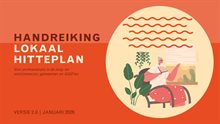
Local Heat Plan Manual
A local heat plan sets out goals and agreements relating to the prevention of health issues caused by heat, especially among vulnerable groups. It also charts the efforts already being made within a municipality, such as various types of agreements and measures. These may involve tasks and activities to be carried out during a hot period, when the National Heat Plan is activated. Other examples are measures that are taken before the start of the summer period. This Manual (pdf, 3.3 MB) helps municipalities to draw up or further develop such a local heat plan, together with local parties and healthcare organisations.
For whom?
The Manual is intended for municipalities, healthcare and welfare staff, community health services, housing corporations and other local parties supporting vulnerable groups. The Manual can be used when drawing up a local heat plan from scratch, but also by those intending to further develop or improve an existing heat plan.
How can the Manual be used?
The Manual explains what a local heat plan is and how such a plan can be developed. It also provides an overview of the various roles and duties in each phase and shows how the local heat plan can annually be implemented, assessed and further developed. For easy reference and to provide a more specific picture, the Manual contains a separate module for each target group, containing examples of communication, information provision and support. The Manual comes with a separate step-by-step plan and a self-assessment to check your progress with the heat plan.
Lessons learned from local heat plans
Are you interested in lessons to be learned from other local heat plans? Under the LIFE-IP Climate Adaptation programme, the province of Utrecht has commissioned an assessment of seven local heat plans. This assessment can be found under the results on the Combating Heat Stress project page of the LIFE-IP Climate Adaptation programme.
Who has developed the Manual?
The Manual and the corresponding step-by-step plan have been developed by a working group of Dutch community health services and TAUW Environmental Engineering Consultancy, on the instructions of the Ministry of Health, Welfare and Sport and the National Institute for Public Health and the Environment (RIVM). This Manual supersedes the previous Manual dating from 2019 (pdf, 685 kB).
Date of publication
March 2026