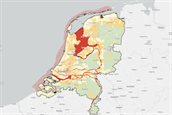
Spatial Assessment Framework for Climate-adaptive Built Environments
The “Spatial assessment framework for climate-adaptive built environments” is an instrument that helps to strengthen the guiding role of water and the soil in spatial developments. It provides more clarity regarding suitable locations and construction methods. The framework comprises map materials, a decision tree, an explanation, information on action perspectives, and information on the subsequent process.
For whom?
The spatial assessment framework is intended for everyone involved in making spatial choices regarding the construction of houses, industrial estates, worksites and public buildings. It is mainly aimed at government authorities, construction sector parties and other institutions involved in spatial choices.
How can it be used?
This instrument helps to strengthen the guiding role of water and the soil in spatial developments. It provides more clarity regarding suitable locations and provides insight into what is needed in an area designated for construction. The greater the challenges faced at a particular location, the more knowledge and resources climate-proof construction will require.
The spatial assessment framework is intended for use in spatial policy development and decision-making. Preferably, it is used in the earliest possible stages of the policy development process. The national government is taking account of the assessment framework in its choices, such as the new Spatial Memorandum.
Who developed the spatial assessment framework?
The spatial assessment framework has been developed by the Ministry of Infrastructure and Water Management (IenW) and the Ministry of the Interior and Kingdom Relations (BZK), in coordination with the Association of Netherlands Municipalities (VNG), the Association of Provincial Authorities (IPO), the Dutch Water Authorities (UvW), and other parties within the construction sector, the development sector and the financial sector. Several knowledge parties have been involved in the development, as well as regional governments that have already developed similar instruments.
Date of publication
9 April 2024