Waterlogging
Between 1910 and 2022, annual precipitation in the Netherlands increased by 26 per cent. Winters have become particularly wetter, but summers have also seen more precipitation. Severe and prolonged precipitation can result in waterlogging. This can cause damage to buildings and make roads impassable. In the future, extreme precipitation, torrential rain and prolonged rainfall will occur more frequently due to climate change. Summer downpours, in particular, may become even more extreme. This will add to the probability of waterlogging.
Unprecedented extreme downpours in Limburg in 2021
The extreme downpours that occurred in the summer of 2021 in the Dutch province of Limburg, in Germany and in Belgium were unprecedented. Such an event hasnot yet beentaken into account in climate stress tests. In order for other parts of the Netherlands to learn from this extreme situation in Limburg, the Waterlogging and Flood Policy Platform was set up, whose final report was published in 2022. Furthermore, in 2022 and 2023, a method was developed under the National Water and Climate Knowledge and Innovation Programme (NKWK) to gain insight into how such a “water bomb” may impact a particular area. Based on these results, a Guide to supra-regional waterlogging stress tests was published in January 2024, followed by the Large-scale extreme rain map narrative in October 2025. Supra-regional stress tests are currently being conducted, using the guide and the map narrative, among other tools.
What does this knowledge dossier feature?
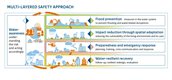
This knowledge dossier provides information on the causes and consequences of waterlogging, and on the effects of various measures to combat waterlogging. It also presents results of various studies into this issue. The section entitled “What can we do to combat waterlogging?” provides more information on the multi-layered safety approach. In addition to the prevention of flooding and waterlogging, this strategy addresses minimising consequences through spatial adaptation, preparedness and emergency control, water-resilient recovery and raising water awareness. See below for the infographic on the multi-layered safety approach.
- How is precipitation changing?
- What can cause waterlogging?
- What are the potential consequences of waterlogging?
- What can we do to combat waterlogging?
- How has the Netherlands organised waterlogging strategies?
- Waterlogging and Flood Policy Platform
Something missing? Let us know!
Are you aware of a study or source in the field of waterlogging that is not mentioned here? Then please share this information with us via the contact form.